A Budget Number Built Around the Kitchen Table
Budget day usually produces two kinds of climate figure: the big departmental total that makes the headlines, and the smaller line items that decide whether anything changes on an ordinary street. Budget 2027, announced on 6 October 2026, is notable because both kinds of number point in the same direction.
The Minister for Climate, Energy and the Environment, Darragh O'Brien, has secured €1.28 billion for his department in 2027 to speed up Ireland's move to a secure, sustainable and affordable energy system. Minister for Public Expenditure Jack Chambers rounded it to €1.3 billion in his Budget statement to the Dáil, and confirmed the part that matters most for households: a record capital allocation of €654.5 million for SEAI's residential and community energy upgrade schemes.
In plain terms, roughly half of the department's entire budget for next year is going into the homes, schools, sports clubs and community buildings where people actually use energy. That is a deliberate choice, and it reflects where Irish climate policy has moved over the past two years — away from long-range targets on paper and towards money people can apply for this month.
Where the €1.28 Billion Is Going
The largest block, more than €950 million, is earmarked for delivering a secure, sustainable and affordable energy sector. That covers the work that rarely makes the evening news but makes everything else possible: support for renewable electricity, the systems that allow new wind and solar to connect, and the retrofit schemes that cut demand at the same time as new clean supply comes on stream.
The SEAI allocation sits at the heart of it. A record €654.5 million gives the authority more room than it has ever had to approve grants, clear applications and fund fully paid upgrades for the households least able to pay for them. The Government's own guide to Budget 2027 describes it simply: enhanced retrofit and solar panel supports to help more families make their homes cheaper to run.
The rest of the department's budget supports climate action, the circular economy and environmental protection — the work that has already produced results this year, from Ireland's 2.2% emissions cut in 2025 to the Circular Economy Innovation Grant Scheme that doubled to €1.5 million in September.
The New Grants: What Changed on 6 October
The Budget money arrives alongside a package of enhanced grants that Minister O'Brien announced on 29 September, developed through the National Energy Affordability Taskforce. The measures opened from 6 October 2026, and they are the part of this story most readers can act on straight away.
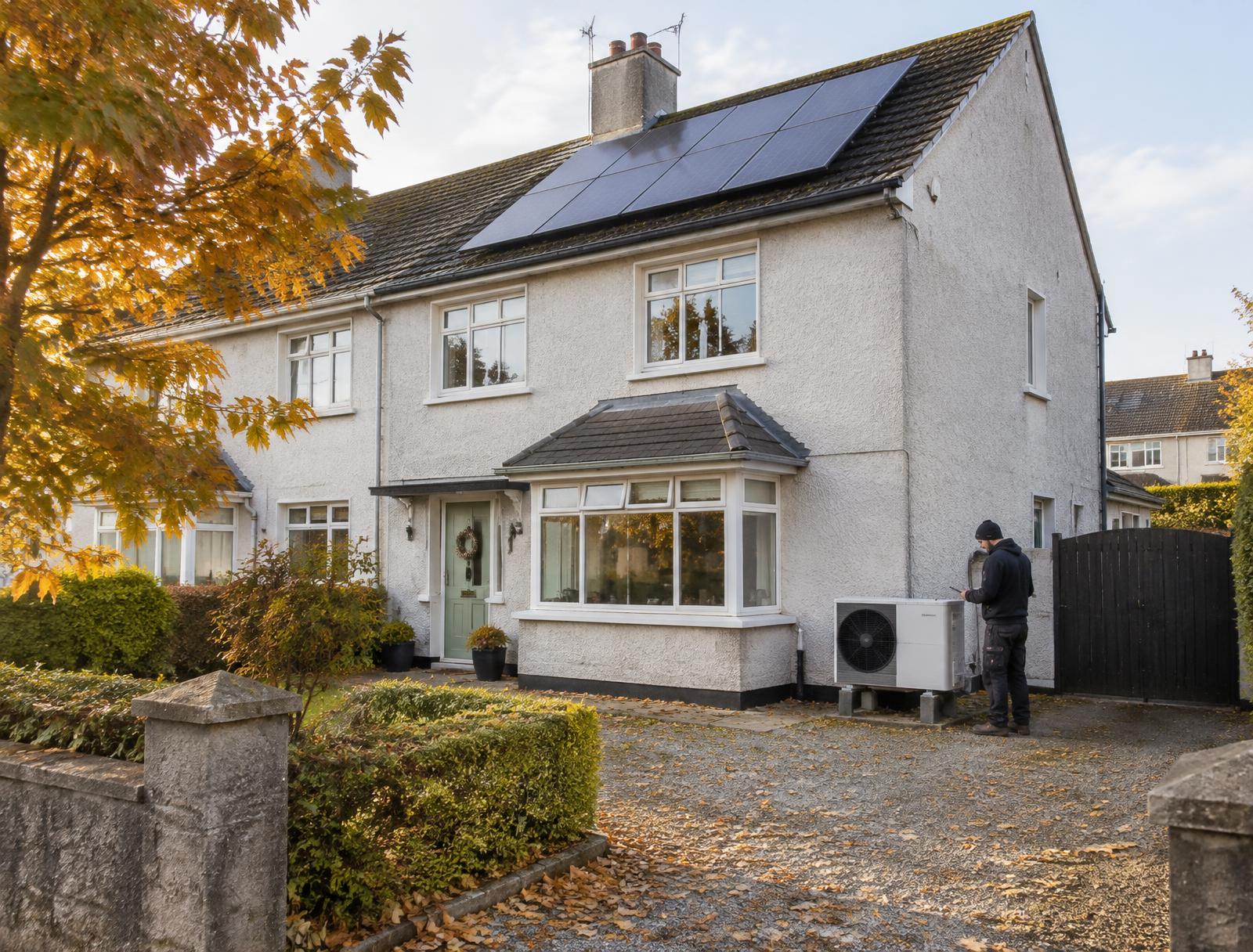
The headline is a new €2,000 boiler scrappage grant for owners of homes built before 2021 who replace a fossil fuel boiler with a heat pump or another renewable heating system. For anyone who already has a heat pump application in progress, the extra €2,000 is added automatically — no new form, no second application. For a family weighing up whether to finally retire an old oil boiler, that changes the arithmetic in a very real way.
The second big change is to the Warmer Homes Scheme, SEAI's fully funded upgrade programme for lower-income households. Solar PV and battery storage are now offered as standard, with up to 4kWp of solar panels and a 5kWh battery. Until now, the households most exposed to high bills were often the last to get the technology that cuts them the most. That gap is now closing.
There is also a new domestic battery grant of €600, wider eligibility for solar PV, and up to €9,000 towards solar PV and battery systems for eligible homeowners receiving certain social welfare payments. More generous insulation and solar supports are being extended to households in HAP, RAS and RASP tenancies, bringing renters into a system that was long built mostly around owner-occupiers.
What It Means in Euro and Cent
The Government's figures put a clear value on the upgrades. Households taking up the newly enhanced grants can save up to €878 a year. When those measures are combined with existing supports — insulation, windows and doors, and heat pumps installed as part of a whole-home upgrade — homeowners can save up to €1,120 a year.
Businesses are not left out. The non-domestic microgeneration grant has been temporarily raised to 45% of eligible costs, and grant support for business heat pumps and solar thermal systems has also been raised to 45%. According to the Department, businesses using the enhanced solar PV supports could cut annual energy costs by up to €300,000. For a hotel, a food producer or a manufacturing plant on a busy industrial estate, that is the difference between treating solar as a nice-to-have and treating it as a straightforward business decision.
The timing matters too. Every euro saved on an energy bill stays in a household budget or on a company's balance sheet, and every fossil fuel boiler taken out is a little less exposure to volatile imported fuel prices. That is exactly the brief the National Energy Affordability Taskforce was set up to deliver.
How Is It Actually Going?
The honest picture is one of momentum. Ireland is retrofitting homes at a record pace, renewable generation is connecting to the grid in growing volumes, and emissions fell again in 2025. Budget 2027 does not change direction — it puts more money behind a direction that is already working, and it aims that money at the people who were hardest to reach.
The next test is delivery. A record grant budget is only as good as the number of homes it reaches, which means SEAI processing applications quickly, enough trained installers to meet demand, and grid connections keeping pace with new rooftop solar. The automatic €2,000 top-up for existing heat pump applicants is a good sign: it shows a scheme being designed around the user, not the paperwork.
For householders, the practical step is simple. If you have been thinking about a heat pump, solar panels or a battery, now is the moment to check what you qualify for on SEAI's website. If you are on a qualifying social welfare payment or renting under HAP, RAS or RASP, the supports open to you are wider than they have ever been.
The Bottom Line
Budget 2027 gives the Department of Climate, Energy and the Environment €1.28 billion, with more than €950 million for a secure, sustainable and affordable energy sector and a record €654.5 million for SEAI home and community upgrades. Since 6 October, homeowners switching from a fossil fuel boiler can get an extra €2,000, Warmer Homes now includes free solar panels and a battery as standard, and renters and welfare recipients have better access than ever. With savings of up to €1,120 a year for a whole-home upgrade and up to €300,000 a year for businesses using solar, the money is now aimed squarely at the front door — and that is where Ireland's energy transition will be won.
Sustainability Pulse covers climate, energy, ESG and environmental policy through an Irish lens. Subscribe to the Sustainability Pulse Briefing — every Wednesday.