The Award
At the 2026 Business & Finance ESG Awards, held in partnership with Grant Thornton, Dalata Hotel Group received two significant recognitions: ESG Team of the Year and the overall Grand Prix Award. The Grand Prix is the programme's highest honour, awarded for outstanding overall ESG performance across environmental, social and governance pillars. The judges described Dalata as "a strong example of ESG delivered through teamwork and alignment." The ESG Team of the Year award recognised the collective effort of Dalata's central office managers working across sustainability priorities from carbon reduction to employee wellbeing.
For Dalata — Ireland's largest hotel operator, with a portfolio of Clayton and Maldron hotels across Ireland, the UK and continental Europe — the awards represent a public validation of an ESG programme built over several years. But what makes Dalata's ESG story interesting from a thought leadership perspective is not the award itself but the specific operational choices that produced it: the practical decisions a large, multi-site hospitality business made about energy, waste, supply chain and workforce that turned a sustainability ambition into a measurable, verified performance record.
Who Dalata Is
Dalata Hotel Group was founded in 2007 and has grown to become Ireland's largest hotel operator, operating 39 hotels with over 7,500 rooms under the Clayton and Maldron brands across Ireland and the UK. In 2024, the group made a significant strategic move, with Pandox AB, the Swedish hotel property company, acquiring a major stake — a transaction that brought Dalata into a wider European hotel investment network. Dalata operates hotels it owns outright, hotels it leases, and hotels it manages under agreement, giving it a diverse operational model that creates both economies of scale in procurement and energy management and complexity in delivering consistent ESG performance across different ownership and lease structures.
The ESG programme Dalata has built operates across all three pillars. On the environmental side, Dalata targets a 15% reduction in water consumption per sleeper by 2026 from a 2019 baseline, alongside a 15% reduction in food waste per sleeper over the same period. The group achieved its target to divert 100% of waste from landfill in 2022 — a milestone it has maintained since. New hotel developments are built to BREEAM Very Good standards, placing them in the upper quarter of new non-domestic buildings by sustainability assessment. All hotels hold Gold Green Tourism accreditation, and the group reports to the Carbon Disclosure Project, where it currently scores a B rating.
The First All-Electric Hotel: Maldron Croke Park
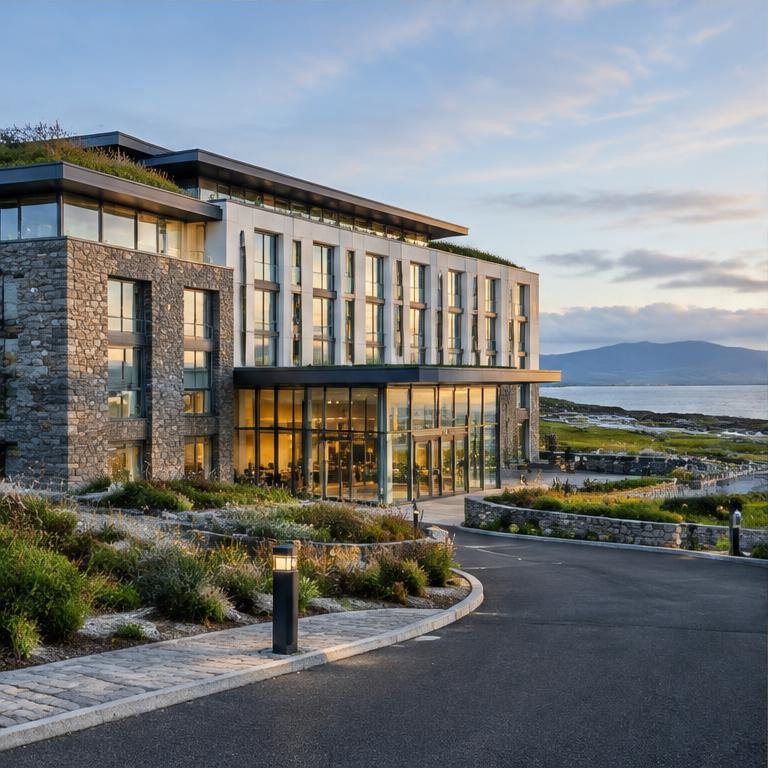
The most concrete expression of Dalata's current sustainability ambition is the Maldron Hotel at Croke Park in Dublin, which is scheduled to open in July 2026 as the group's first all-electric hotel. The significance of this milestone sits in the context of the Irish hospitality sector's broader energy transition challenge: hotels are high-energy-use buildings, with significant consumption from heating, air conditioning, laundry, kitchens and guest room services. A large urban hotel built to operate entirely on electricity, rather than a combination of electricity and gas, represents a genuine engineering and commercial commitment, not a marginal efficiency improvement.
The Maldron Croke Park development is not only Dalata's first all-electric hotel but also a demonstration project for what the group is committing to in its future hotel development pipeline. The group's stated approach for new developments targets reduced impact both in the long-term operational carbon profile and in the day-to-day impact of construction, with materials selected on the basis of whole lifecycle assessment rather than upfront cost alone. For a hotel operator building new properties across Ireland, the UK and continental Europe over the next five years, the choices made in each development about energy systems, building fabric and fit-out materials will determine the group's Scope 1 and 2 emissions trajectory for decades.
The Supply Chain Commitment
One of the more demanding elements of Dalata's ESG programme is its supply chain carbon commitment: collecting Scope 1 and 2 carbon emissions data from 100% of its Tier 1 suppliers, a target it set for 2024. This is a Scope 3 emissions reporting requirement — measuring the emissions generated by the companies that supply to Dalata, rather than only the emissions from Dalata's own operations. Scope 3 reporting is widely acknowledged as the most difficult and least standardised part of corporate carbon accounting, requiring suppliers to have their own emissions measurement capability and to share that data consistently and accurately.
Dalata's commitment to collecting this data from 100% of Tier 1 suppliers by 2024 is meaningfully more ambitious than what most Irish hospitality businesses — and indeed most Irish businesses of any kind — have attempted in the supply chain emissions space. It creates a direct commercial incentive for Dalata's suppliers to invest in their own emissions measurement capability, and it gives the group a more accurate and complete picture of its total carbon footprint than a Scope 1 and 2 only approach would provide.
The People Dimension: Why ESG Team of the Year Matters
The ESG Team of the Year recognition at the 2026 awards is, in some respects, as significant as the Grand Prix in what it signals about how Dalata approaches sustainability governance. The judges cited Dalata as "a strong example of ESG delivered through teamwork and alignment" — recognising not the output of a standalone sustainability function but the distributed ownership of ESG across the group's central office management teams. This is a governance model that differs from the siloed sustainability department approach still common in many large organisations, where ESG reporting is a specialist function disconnected from the operational decisions that actually drive environmental and social performance.
Dalata's model, by contrast, embeds sustainability priorities across multiple management functions — facilities management, procurement, food and beverage, HR, development — with the sustainability team acting as coordinator and framework provider rather than sole decision-maker and reporter. The practical benefit of this model is that the people making operational decisions about energy systems, food purchasing, waste management and workforce practice are directly accountable for ESG performance in their area, rather than providing data to a separate function that then reports it externally. That alignment between operational responsibility and ESG accountability is, according to the awards judges, what distinguishes genuinely embedded ESG programmes from those that are primarily reporting exercises.
What the Irish Hospitality Sector Can Learn From This
Dalata's ESG programme is not a template that every Irish hospitality business can adopt directly — the resources available to a publicly listed hotel operator are not available to a family-run hotel or a regional guesthouse. But several elements of the Dalata approach are instructive regardless of scale. The commitment to verifiable, target-based performance measurement rather than narrative ESG communication is replicable at any level of the sector, even if the specific targets differ. The focus on waste-to-landfill diversion, food waste reduction, water efficiency and supplier engagement are areas where any hospitality business can make meaningful progress with appropriate measurement systems in place. And the governance model of distributing ESG ownership across operational teams, rather than centralising it in a standalone function, is arguably more achievable for smaller businesses than the resource-intensive equivalent of a standalone ESG department.
For the broader Irish business community, Dalata's 2026 Grand Prix win is a useful reminder that the most credible ESG programmes are built on operational decisions and measurable outcomes rather than communications investments — and that the awards and reputational recognition that flow from genuine ESG performance are, in the end, a consequence of the work rather than a substitute for it.
The Bottom Line: Dalata Hotel Group's 2026 ESG Grand Prix reflects a programme built on specific, measurable operational commitments — from 100% waste diversion from landfill to Scope 3 supply chain data collection to the first all-electric hotel in the group's portfolio. The awards validate the programme's breadth and credibility. The operational decisions behind them are the more instructive story for Irish businesses navigating their own ESG transition.
Sustainability Pulse covers climate, energy, ESG and environmental policy through an Irish lens. Subscribe to the Sustainability Pulse Briefing — every Wednesday.