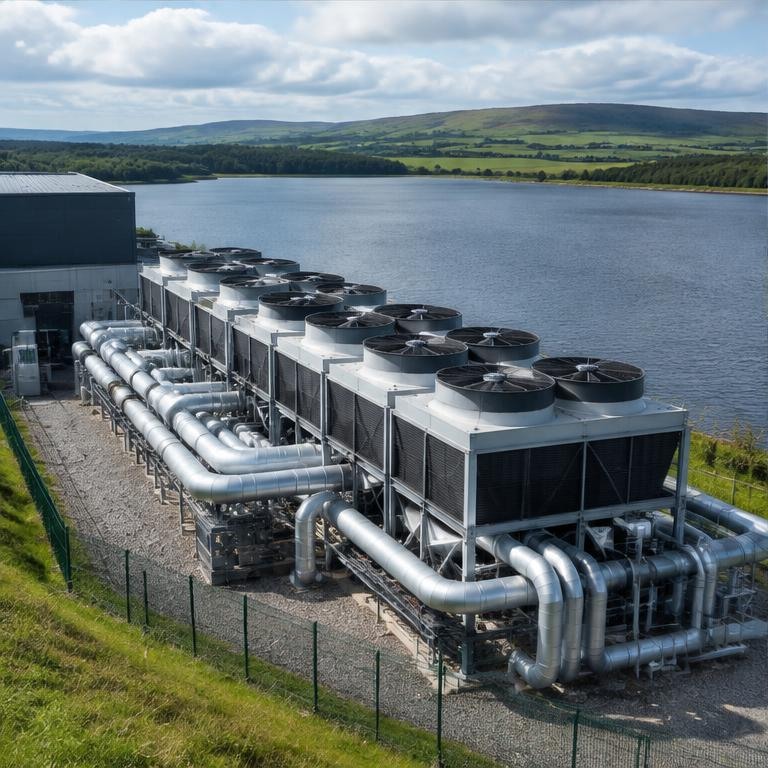
How Ireland Became Europe's Data Centre Destination
Ireland's position as a hub for data centre investment didn't happen by accident. A combination of a 12.5% corporate tax rate on trading income, an English-speaking workforce, EU market access, a cool Atlantic climate that reduces cooling costs, and good fibre connectivity made Ireland an attractive base for US technology multinationals from the early 2000s onwards. Microsoft, Meta, Google and Amazon all established significant data centre campuses here, and over time the clustering effect of their presence made Ireland even more attractive to others following in their wake. According to KPMG's 2026 report commissioned by the Department of Enterprise, the data centre landscape in Ireland grew from 100 megawatts of installed IT capacity in 2010 to 1,543 megawatts by 2025 — a fifteenfold increase in fifteen years. A further 300 megawatts of grid connections are already contracted for existing operators, and EirGrid estimates that additional demand from data centre operators over the fifteen years to 2040 could reach 5.8 gigawatts.
The scale of that expansion has created a genuine national policy dilemma that is now playing out in real time across government, the energy sector, and communities across Ireland. The economic case for data centres is well documented and substantial. The environmental and social costs are equally documented and increasingly hard to ignore. Ireland is now trying to manage both simultaneously, and the decisions being made in 2026 will shape the country's energy, climate and economic landscape for decades.
The Economic Case: €7.3 Billion Added to the Irish Economy
The positive case for data centres rests on numbers that are, in the context of the Irish economy, genuinely significant. Data centre operations are estimated to have added €7.3 billion to the Irish economy, according to research cited by the Irish Institute of International and European Affairs in December 2025, drawing on Trinity School of Business analysis. The same research suggests that AI adoption — which data centre infrastructure directly enables — could add between €250 billion and €310 billion in additional GDP by 2035, depending on policy choices made in the near term.
Corporation tax, paid largely by the US technology multinationals that operate Irish data centres, accounted for approximately one third of all Irish tax revenues in 2025, according to analysis published by the Irish News. That tax revenue funds public services, capital investment and the government's 2026 capital plan of €19.1 billion — a 56% increase from €8 billion just two years earlier — which Minister Paschal Donohoe referenced directly when speaking at a Microsoft event in February 2026. Data centres also generate significant construction employment during build phases and operational employment in facilities management, security, electrical engineering and IT management once operational. KPMG's analysis for the Department of Enterprise confirmed that economic impacts from data centre construction and operation peaked in 2020 but have remained a consistent contributor to employment and employment-related tax receipts through the 2010-2024 period.
There is also a strategic dimension to the economic argument. Data centre investment is intensely competitive at a European level. France announced €200 billion in data centre investment in March 2025. Germany attracted €100 billion the year before. As Host in Ireland CEO Garry Connolly put it, data centre investment is happening — just not necessarily in Ireland if the grid constraints remain unresolved. Every megawatt of capacity that diverts to France, Germany or the Netherlands is a permanent loss of economic activity that Ireland is structurally well positioned to attract.
The Energy Cost: 32% of Ireland's Electricity and Rising
The environmental case against unchecked data centre expansion in Ireland is equally grounded in verified data. Data centres accounted for 21% of Ireland's total metered electricity consumption in 2023, according to the CSO, up from 5% in 2015 — a fourfold increase in eight years. By 2026, that share is projected to reach 32%, according to Carbon Brief analysis cited by the IIEA. The Irish Times reported in February 2026, following a rare access visit to Microsoft's Dublin campus, that data centres used more electricity in 2024 than every home in every Irish city and town combined. By 2030, Wood Mackenzie and Pinergy project that data centres will consume 8.6 terawatt hours of electricity annually — the equivalent of powering two million homes.
That consumption trajectory sits in direct tension with Ireland's climate commitments. Ireland's second carbon budget, legally binding under the Climate Action and Low Carbon Development Act 2021, limits the power sector to 200 million tonnes of CO₂ equivalent for the 2026-2030 period. The SEAI has warned that unchecked data centre growth could cause Ireland to exceed that budget. EirGrid's All-Island Resource Adequacy Assessment, published in February 2026, warned that electricity demand will exceed supply capacity during peak periods between 2026 and 2028 — a grid stress scenario that has already led to a de facto pause on new data centre electricity connections in the Dublin and Greater Dublin area until 2028.
Paul Deane, Senior Researcher at University College Cork, told Energy Ireland that to hit the 80% renewable electricity target by 2030 under a medium data centre build-out scenario, Ireland needs to deliver 700 megawatts of new onshore renewables every year from 2025 to 2030. Ireland has historically delivered between 400 and 500 megawatts a year. The gap between what is needed and what has been built is, in Deane's words, creating "spillover effects into climate targets."
The Household Cost: €1.43 Billion in Higher Bills
The social cost of data centre electricity demand falls most directly on Irish households. A report by Friends of the Earth Ireland, published in May 2026, found that data centre growth added €715 million to Irish household electricity bills between 2015 and 2023. The same report projects a further €1.43 billion in additional household electricity costs linked to data centre growth between 2025 and 2034. The poorest households paid an extra €209 on electricity bills between 2021 and 2023 specifically because of data centre-related grid costs, according to the same analysis. ESB Networks already added €1.75 per month to household electricity bills from October 2025 to fund grid infrastructure upgrades, upgrades that are driven in significant part by data centre demand. From June 2026, Irish electricity suppliers are required to offer dynamic tariffs where prices change every 30 minutes based on wholesale costs — a structural shift that is partly a response to the volatility that large industrial electricity consumers, including data centres, introduce into the grid.
What Ireland Is Doing About It
The government's response has centred on the Large Energy User Action Plan, known as LEAP, and the development of a new data centre policy framework that links grid connection approvals to renewable energy commitments. Under the CRU's current requirements, data centres must meet 80% of their electricity demand with renewable energy as a condition of grid access — a policy that has driven investment in corporate power purchase agreements and on-site renewable generation. Ireland's first data centre microgrid, powered by renewable energy independent of the public grid, launched in Dublin in March 2026, pointing toward a model that reduces data centres' dependence on the national grid while still enabling their operation.
Under the EU's recast Energy Efficiency Directive, in force from May 2025, data centres are now required to report annually on their energy use and environmental impact — a transparency obligation that didn't previously exist. A National Private Wires Policy Framework is also in development, which would allow data centres and other large energy users to connect directly to renewable energy sources via dedicated cables without routing through the public grid, potentially unlocking significant additional capacity without adding load to a constrained system.
The Honest Balance Sheet
The data centre debate in Ireland is genuinely complex, and the honest answer is that neither the economic case nor the environmental and social costs can be dismissed. €7.3 billion added to the economy and a corporation tax contribution that funds public services are real. So is 32% of national electricity consumption, €1.43 billion in projected additional household bills, and the risk of breaching legally binding carbon budgets. Ireland's policy challenge is to find a path that maintains the economic benefits of being a significant data centre location while addressing the grid, climate and household cost consequences of the current trajectory. The LEAP framework, the renewable energy commitment requirements and the new EU reporting obligations are all steps in that direction. Whether they are enough, and fast enough, is the question that Ireland's energy and climate policymakers are trying to answer right now.
The Bottom Line: Ireland's data centres are a genuine economic asset and a genuine environmental and social challenge simultaneously. The verified data on both sides of that ledger is now clear enough that the policy debate has moved past whether there is a problem to how to manage it — and the decisions being made in 2026 on grid access, renewable energy requirements and household cost protections will define which side of that balance sheet dominates for the decade ahead.
Sustainability Pulse covers climate, energy, ESG and environmental policy through an Irish lens. Subscribe to the Sustainability Pulse Briefing — every Wednesday.