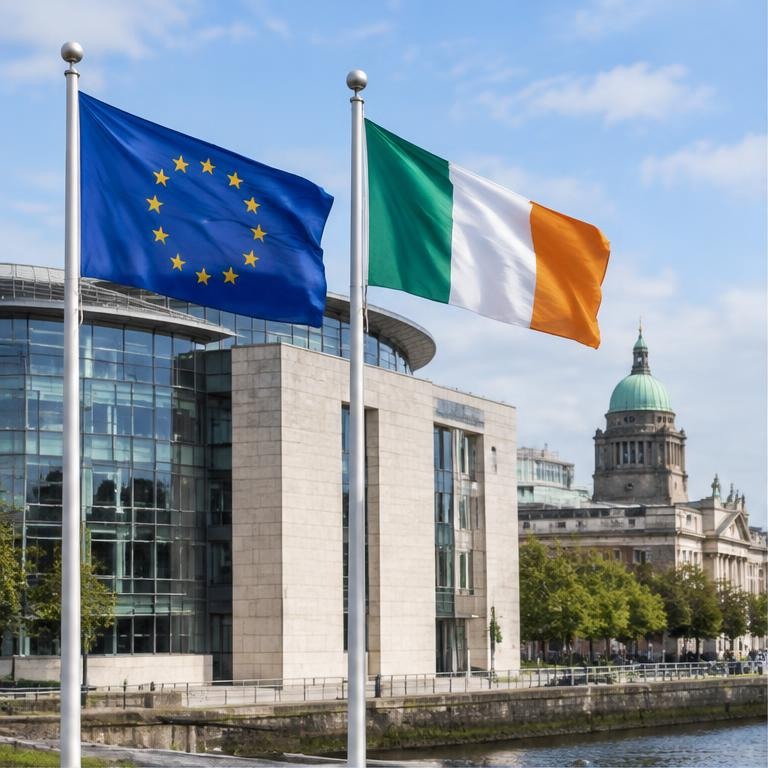
The EU-US trade deal finalised in May 2026 is primarily discussed as a tariff and trade story. For sustainability and ESG professionals in Irish organisations, it is also a strategic inflection point — one that changes the competitive context for green investment, reshapes supply chain sustainability calculations and adds new urgency to ESG compliance programmes that were already under pressure.
Here is what Irish sustainability leaders need to understand about the deal and its implications.
The Carbon Border Adjustment Mechanism — A New Complexity
The EU's Carbon Border Adjustment Mechanism — which entered its transitional phase in October 2023 and moves to full implementation in 2026 — applies a carbon price to imports of specified goods from countries without equivalent carbon pricing. The goods currently covered include cement, iron and steel, aluminium, fertilisers, electricity and hydrogen.
The EU-US trade deal does not resolve the CBAM question for US exports. The United States does not have a national carbon price. American goods entering the EU in CBAM-covered sectors will be subject to carbon adjustment charges that reflect the difference between their embedded carbon cost and the EU carbon price.
For Irish businesses that source materials or components from the US in these sectors, the CBAM adds a cost layer that the trade deal's tariff reductions do not offset. Understanding the embedded carbon content of US-sourced inputs — and factoring that cost into procurement decisions — is now a commercial as well as an environmental imperative.
Supply Chain Sustainability — The Reshoring Signal
One of the less-discussed dimensions of the EU-US tariff deal is its effect on supply chain geography. The 15 per cent tariff on EU goods entering the US — combined with the EU's elimination of tariffs on US industrial imports — creates a set of incentives that will influence where companies source materials and locate production.
For Irish businesses, the deal strengthens the case for European sourcing strategies over transatlantic ones in many categories. Products manufactured within the EU face a 15 per cent tariff on export to the US — but goods manufactured in the US and imported to the EU now enter at zero tariff on industrial goods. That asymmetry changes the economics of supply chain decisions in ways that have direct sustainability implications.
Supply chains that shift toward European sourcing are generally shorter, lower in transport emissions and easier to verify for ESG reporting purposes. The Corporate Sustainability Reporting Directive requires large Irish companies to report on Scope 3 emissions — the emissions embedded in their supply chains — and shorter, more proximate supply chains produce materially lower Scope 3 figures.
The trade deal, counterintuitively, may accelerate supply chain reshoring decisions that simultaneously improve ESG performance and reduce compliance complexity.
ESG Reporting — The CSRD Doesn't Wait for Trade Policy
The Omnibus 1 Directive, which came into force in March 2026, delayed the CSRD reporting obligations for Wave 2 companies by two years. But Wave 1 companies — those previously subject to the Non-Financial Reporting Directive — are already reporting, and the broader direction of travel in EU sustainability disclosure requirements has not changed.
The EU-US trade deal creates no exemption, no delay and no simplification in ESG reporting obligations. Irish companies subject to CSRD still need to report on their climate risks, their Scope 1, 2 and 3 emissions, their governance approach to sustainability and their transition plans. The trade deal changes the commercial context in which those plans are implemented — it does not change the requirement to have them.
What it does change is the benchmark against which Irish companies will increasingly be assessed. US competitors — many of whom face less stringent sustainability disclosure requirements than their EU counterparts — will continue to enter the EU market at zero tariff on industrial goods under the new deal. The EU's sustainability reporting framework therefore needs to be understood not as a cost burden but as a competitive differentiator — evidence of managed, verifiable, long-term resilience that US competitors may not be able to match.
The Pharmaceutical Uncertainty — An ESG Risk
The unresolved Section 232 investigation into pharmaceutical imports — which could result in US tariffs on pharmaceuticals higher than the 15 per cent deal rate — is not only an economic risk for Ireland. It is an ESG risk.
Ireland's pharmaceutical sector has invested significantly in the sustainability credentials of its manufacturing operations — in energy efficiency, water use reduction, waste minimisation and emissions reporting. Those investments are made on the assumption of stable, long-term market access.
A higher pharmaceutical tariff under Section 232 would not negate those investments — but it would reduce the commercial return on them by increasing the cost pressure on Irish pharmaceutical manufacturing relative to US-based production. Sustainability investment and commercial resilience are not separable: an operation under margin pressure is an operation with less capacity to invest in decarbonisation.
The Section 232 outcome, expected in the coming weeks, is therefore a material item on the ESG risk register of every Irish pharmaceutical manufacturer.
What Sustainability and ESG Leaders Should Do Now
Revisit supply chain sustainability assessments in light of the new tariff landscape and the opportunities for European sourcing strategies that reduce Scope 3 emissions.
Ensure CBAM compliance processes are in place for any US-sourced inputs in covered sectors — cement, steel, aluminium, fertilisers, electricity and hydrogen.
Confirm that CSRD reporting timelines and Wave 1 obligations are on track — the trade deal creates no delay.
Monitor the Section 232 pharmaceutical investigation closely and assess its implications for capital investment planning in Irish pharmaceutical manufacturing.
Use the EU's more stringent sustainability reporting framework as a competitive differentiator in conversations with investors and customers — not as a compliance burden to be minimised.
The Bottom Line
The EU-US trade deal reshapes the competitive and commercial landscape for Irish business. For sustainability and ESG professionals, it adds complexity to supply chain decisions, reinforces the strategic value of European sourcing and leaves an unresolved pharmaceutical risk on the table.
The CSRD doesn't care about tariff deals. The climate targets don't move based on trade negotiations. What the deal does is change the commercial context within which Irish organisations pursue their sustainability commitments — and in some respects, it strengthens the case for accelerating them.
Sustainability Pulse covers climate, energy, ESG and environmental policy through an Irish lens. Subscribe to the Sustainability Pulse Briefing — every Wednesday.