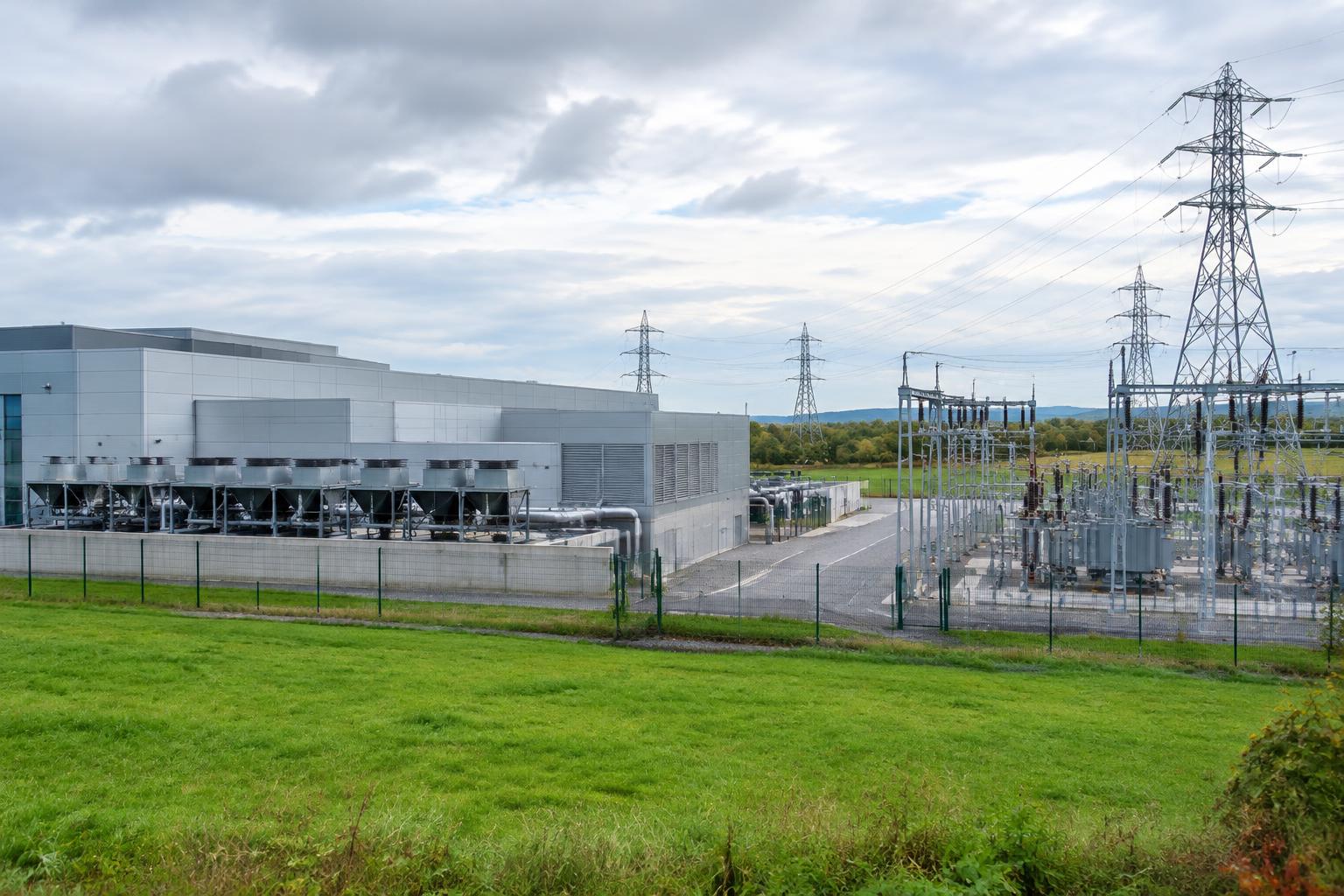
Ireland's data-centre sector has grown into one of the most closely watched parts of the national electricity system, and new figures combined with new regulation give an updated picture of where things stand. The headline number, from the Central Statistics Office, is that data centres consumed 7,663 GWh of metered electricity in 2025 — 23% of the country's total metered electricity, up from 22% in 2024. That is a substantial share, built on roughly 518% growth in data-centre consumption since 2015, when the sector used just 1,240 GWh, or 5% of the total.
It is not, however, a figure that exceeds 30%, nor one that places all other sectors in the shade: combined urban and rural households accounted for 28% of metered electricity in 2025, meaning homes collectively still used more power than data centres did.
What the Numbers Actually Show
Three distinct measures are often blurred in discussion of Ireland's data-centre footprint, and separating them matters. The first is metered annual electricity consumption — the CSO's 7,663 GWh figure for 2025, an actual recorded outcome, not a live 2026 reading or a projection.
The second is connection or generation capacity. A maximum import capacity (MIC) describes the permission a facility holds to draw power from the grid at any moment, measured in megavolt-amps (MVA). Installed generation capacity, by contrast, is measured in megawatts (MW) and describes how much power a generator or storage unit can actually produce — it is not itself a permission to draw electricity. The third measure is peak supply adequacy — whether the grid as a whole can meet maximum demand at the moments when it is tightest, which is a separate question again from either consumption or capacity. Conflating these measures has been a recurring source of confusion in public debate, and keeping them distinct matters for understanding both the scale of the challenge and the shape of the policy response now being rolled out.
The Adequacy Picture From EirGrid
EirGrid's All-Island Resource Adequacy Assessment for 2026–2035, published in February 2026 using assumptions frozen the previous June, found that both its base and secure scenarios exceed the standard three-hour annual Loss of Load Expectation in the years 2026 to 2028. This is a probabilistic reliability measure, not a forecast of blackouts — it describes a statistical risk threshold being crossed, not an outcome that is certain to occur.
The assessment also found that from 2029 the base scenario meets the adequacy standard, while the secure scenario requires roughly 200MW of additional generation capacity initially, rising to over 400MW by 2034. These figures describe gaps in generation capacity that need to be filled over the coming decade — they are not, as sometimes suggested, a measure of how much new annual demand data centres are adding each year. Temporary emergency generation and retained units at Moneypoint were excluded from these scenarios specifically because of their temporary status, which tightens the adequacy picture further.
The December 2025 Connection Rules
A significant recent development is the Commission for Regulation of Utilities' Large Energy Users connection policy, published on 12 December 2025 under decision CRU/2025236. The policy applies to qualifying new connection applications and requests for new additional capacity — it is not retrospective, and facilities with pre-existing applications continue to be processed under the previous framework.
Below 1MVA of maximum import capacity, no new generation or renewable obligations apply, though a location assessment is still required. Between 1MVA and just under 10MVA, an autoproducer unit sized to 100% of the maximum import capacity, subject to de-rating, is required, along with wholesale market participation. At 10MVA and above, applicants must provide dispatchable generation and/or storage, either onsite or in proximity, matching the maximum import capacity subject to de-rating, with separate connection and metering arrangements and wholesale market participation.
Qualifying facilities cannot operate or ramp up without generation and/or storage matching their ramped or enduring maximum import capacity, subject to the de-rating discount applied for availability. Qualifying renewables can receive de-rated credit toward this requirement rather than demanding a blanket fossil-fuel generator on site. For qualifying centres, at least 80% of annual electricity demand must come from additional renewable generation located in the Republic of Ireland, phased in over a six-year glide path from the date of energisation, with a credible delivery plan and annual compliance reporting. Non-compliance after the glide path period can result in a reduction of maximum import capacity.
It is worth being precise about what the 80% figure means: it is an annual matching requirement, not a guarantee of round-the-clock renewable supply at every hour.
Power Purchase Agreements and the Shared Grid
Many data centres secure long-term Power Purchase Agreements with renewable energy developers, contracting the output of specific wind or solar projects to meet their own demand commitments. These grid-connected PPAs are a financial and contractual arrangement, not a physical rerouting of electrons. Electricity generated under such an agreement still flows into the same shared grid as every other generator's output, and the data centre still draws its actual power from that shared system, metered like any other user.
What a PPA does is align the commercial and compliance position of the buyer with a given volume of renewable generation on an annual accounting basis — the kind of mechanism the new 80%-additional-renewables requirement is built around. Under CRU rules, additionality means the renewable capacity procured for compliance must represent genuinely new generation brought onto the system, rather than existing output being reassigned on paper. The detail of how additionality is verified and enforced will determine how robust this safeguard proves in practice.
The Wider Context
A report titled Environmental Cost of AI's Energy Use: Carbon, Water and Land Footprints, published by UNU-INWEH in June 2026, estimated that all data centres globally consumed around 448TWh of electricity in 2025 — a figure that, if data centres were ranked as a country by electricity use, would place them 11th, behind France and ahead of Saudi Arabia. The same report forecast global data-centre electricity use could reach 945TWh by 2030, with AI workloads rising from an estimated 20% of that total in 2025 to around 40%, or roughly 378TWh, by 2030.
Separately, preliminary CRU market-intelligence feedback has referenced a potential additional demand figure in the order of 5.8GW in the medium term — language the regulator itself frames as indicative rather than an approved allocation or a definitive forecast. Academic modelling presented at a June 2026 UCC/ESRI/MaREI seminar explored a conditional scenario in which data centres could account for a much larger share of demand by 2040 under an expansionary policy path, compared with a lower baseline share — an illustration of policy choice rather than a settled prediction.
On the investment side, the ESB confirmed in April 2026 that it invested €2.7 billion in infrastructure during 2025, while Budget 2027 allocated €1.28 billion to the broader climate, energy and environment portfolio — a department-wide figure, not a fund dedicated specifically to data-centre grid connections.
The Bottom Line
Ireland's data-centre sector is a large and still-growing part of the electricity system, but the figures bear precise handling: 23% of metered consumption in 2025, not a majority share. The grid faces a quantified adequacy gap in generation capacity through the late 2020s, distinct from how much electricity data centres consume day to day.
The December 2025 connection rules mark a meaningful shift, requiring new large users to bring matching dispatchable generation and/or storage, participate in the wholesale market, and source the large majority of their demand from additional Irish renewables on a phased, reported basis. PPAs do not create a private electricity supply outside the grid — they are compliance and accounting tools layered onto a single shared system.
Whether these measures keep pace with demand growth will depend on how additionality is verified, how glide-path compliance is enforced, and how quickly the capacity gaps EirGrid has identified are closed. With the new framework now in place, the coming years should offer clearer evidence of whether policy and grid planning can keep step with Ireland's digital growth.