Ireland's electric vehicle market has shifted decisively. After a difficult 2024, in which new EV registrations fell sharply, 2025 delivered a record year — and 2026 is tracking significantly ahead of that record. The momentum is real. But so is the scale of the challenge that remains.
2025: A Record Year
Ireland registered 23,601 new battery electric vehicles in 2025 — a 35 per cent increase on 2024 and the highest annual total on record, surpassing the previous peak of 22,493 in 2023. According to the Society of the Irish Motor Industry, battery electric vehicles accounted for 18.9 per cent of all new car registrations in 2025.
The market share picture is significant. For the first time, electrified vehicles in their various forms — battery electric, hybrid and plug-in hybrid — together accounted for more than 56 per cent of the Irish new car market in 2025. Petrol accounted for 25.1 per cent. Diesel fell to 17.1 per cent.
At regional level, Dublin led with 11,151 new EV registrations in 2025, up 23 per cent on 2024. Cork registered 2,310 new EVs, a 41 per cent increase. The growth was recorded across every county in Ireland.
The bestselling EV brand in 2025 was Volkswagen with 3,266 registrations, followed by Kia with 2,829 and Tesla with 2,769. Hyundai was the only other manufacturer to exceed 2,000 sales, reaching 2,557.
In October 2025, Minister for Transport Darragh O'Brien announced that Ireland had reached its initial climate milestone — 195,000 electric cars on the road by end of 2025. The actual figure exceeded that target, with 196,000 EVs confirmed on Irish roads at that point.
2026: Acceleration Continues
The momentum has continued sharply into 2026.
In the first quarter of 2026, 14,004 battery electric vehicles were registered — a 40.5 per cent increase on the same period in 2025. BEV market share reached 21.5 per cent in Q1 2026, up from 18.9 per cent for the full year 2025.
April 2026 saw 73 per cent more private EV registrations than April 2025, with just under 3,100 registered in the month. May 2026 delivered 2,335 new electric car registrations — 115 per cent higher than the 1,086 registered in May 2025.
As of May 2026, approximately 204,000 battery electric vehicles are on Irish roads — well ahead of the government's 2025 target of 195,000, and continuing to grow.
The Incentives Available in 2026
The government's financial supports for EV adoption have been extended and, from July 2026, significantly enhanced.
The core EV purchase grant provides up to €3,500 for qualifying new battery electric passenger cars. VRT relief of up to €5,000 applies separately. Combined, these supports can reduce the upfront cost of a new EV by up to €8,500 before other savings are considered.
From 1 July 2026, a new ICE2EV Scrappage Scheme opens for applications, operated by SEAI. The scheme offers a €5,000 scrappage payment to drivers who trade in a petrol or diesel car more than 13 years old when purchasing a new electric vehicle. Combined with the existing €3,500 EV purchase grant, the total available support rises to €8,500 for qualifying buyers. The scheme is a €10 million pilot, meaning funds are limited and applications are on a first-come first-served basis.
For home charging, a grant of up to €300 is available toward the purchase and installation of a home charger unit, administered by SEAI on behalf of Zero Emission Vehicles Ireland.
For businesses, the SEAI Workplace Charging Grant covers up to 60 per cent of installation costs, to a maximum of €5,000 per charge point, for businesses installing chargers in workplace car parks for employee use. Accelerated Capital Allowances on energy-efficient vehicles and EV charging infrastructure have been extended to end of 2030.
Company car drivers benefit from a Benefit-in-Kind reduction for EVs in 2026. A €20,000 EV-specific reduction applies alongside a €10,000 universal reduction — a combined €30,000 reduction to the Original Market Value when calculating BIK. This relief tapers in subsequent years.
The Charging Infrastructure: Growing But Not Fast Enough
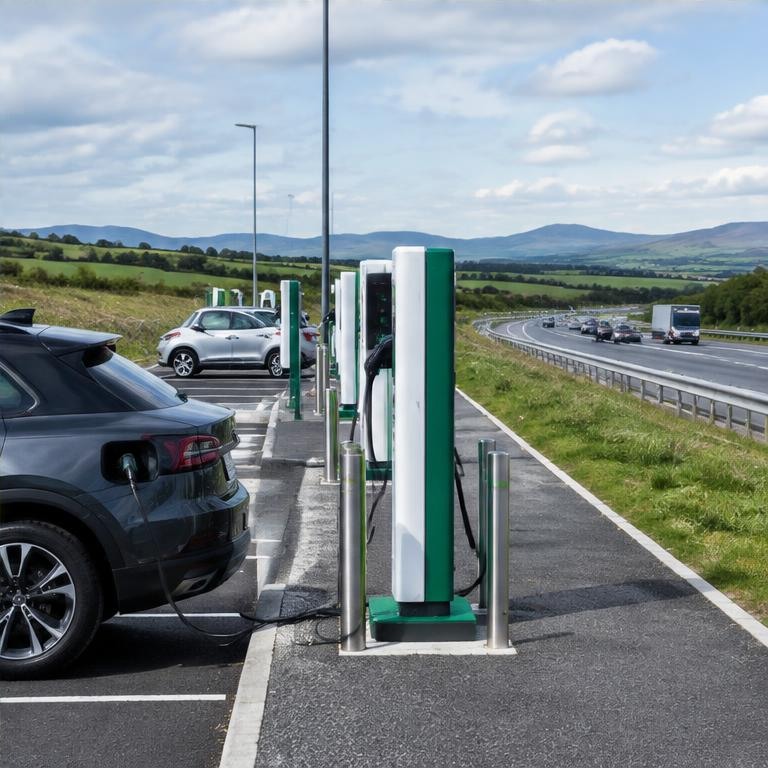
Ireland's public EV charging network has expanded significantly but remains under pressure from rapidly growing demand.
ESB ecars operates the largest public charging network, maintaining over 1,600 charge points across the island of Ireland. The total number of publicly accessible chargers nationwide stands at approximately 3,237, following a 43 per cent expansion in the past twelve months that added 448 new high-power CCS connectors and brought the national total of fast chargers to 1,487, according to the Irish Electric Vehicle Association's 2026 review published in January.
However, the rate of infrastructure growth is not keeping pace with EV adoption. With 204,000 EVs on the road and 3,237 public chargers, Ireland has one public charger for every 63 electric vehicles. The government's target of 936,000 EVs on the road by 2030 would require 16,000 to 20,000 additional public chargers — meaning between 4,000 and 5,000 new public chargers installed every year between now and 2030.
The government's National Road EV Charging Network Plan aims to install high-powered charging hubs every 60 kilometres on motorways and major routes. The EIB Group's advisory agreement with Zero Emission Vehicles Ireland, signed on 1 June 2026, is specifically focused on delivering a comprehensive nationwide public EV charging network.
Rural coverage remains the most significant gap. Urban and motorway charging has improved substantially. The experience for EV drivers in many rural and regional areas remains inconsistent.
The 2030 Target: Ambition Revised Downward
Ireland's original Climate Action Plan target was 936,000 EVs on Irish roads by 2030. The updated Climate Action Plan 2023 revised this to a target of 30 per cent of the national private car fleet being electric by 2030.
Minister O'Brien has acknowledged that the original target of approaching one million EVs by 2030 will not be met. With approximately 204,000 battery EVs currently on the road, reaching 30 per cent of the national fleet by 2030 would require registering in excess of 100,000 new electric cars every year for the next four years. Current annual registration rates, while growing strongly, remain at approximately 23,000 to 30,000 per year.
The gap between the trajectory and the target is significant. The scrappage scheme launching in July 2026 is designed to accelerate the transition — particularly among older, higher-emissions vehicles — and represents a direct response to the advice of Ireland's Just Transition Commission, which called for more targeted supports for high-mileage and car-dependent households.
The Bottom Line
Ireland's EV market is growing faster than at any point in the country's history. Record 2025 registrations, accelerating 2026 numbers, enhanced government incentives and a new scrappage scheme all point in the right direction.
The challenge is that the destination — a meaningful reduction in transport emissions by 2030 — requires a pace of transition that current infrastructure, incentive levels and consumer behaviour have not yet demonstrated at scale.
The momentum is real. Closing the gap between where Ireland is and where it needs to be will require sustained policy, investment and public confidence in the charging network for several years to come.
Sustainability Pulse covers climate, energy, ESG and environmental policy through an Irish lens. Subscribe to the Sustainability Pulse Briefing — every Wednesday.