A Nation's Housing Stock, One Upgrade at a Time
There are approximately 2.2 million homes in Ireland, of which around 1.8 million are occupied. The vast majority were built before modern energy efficiency standards existed — before heat pumps were commercially viable, before building regulations required meaningful insulation, and before the phrase "retrofit" meant anything more to most Irish homeowners than something vaguely to do with kitchens. These homes heat Ireland's families, drive a significant share of national energy demand and, because most of them are still warmed by fossil fuels, contribute substantially to the country's greenhouse gas emissions. The challenge of transforming that housing stock into a low-carbon, energy-efficient, affordable-to-run national estate is one of the most logistically complex climate action tasks Ireland has ever attempted — and it is now, for the first time, being attempted at meaningful scale.
Since 2019, almost €1.7 billion has been provided in SEAI supports, delivering 244,000 home energy upgrades, including 32,700 fully funded retrofits for households at risk of energy poverty and 18,000 heat pump installations. In 2025 alone, 58,128 upgrades were completed under SEAI schemes — a record annual output that confirmed the programme had moved beyond its initial years of process-building and supply-chain development into genuine delivery at scale. The target for 2026 is 73,000 upgrades. Applications for individual home energy upgrades are up 186% on the first quarter of 2025, with overall applications up 96% year on year by the end of the first quarter of 2026, with 29,000 applications processed between January and March.
The Plan and the Stakes
Ireland's national target is to retrofit 500,000 homes to a BER B2 or better standard and install 400,000 heat pumps in existing homes by the end of 2030. To achieve the overall target of 500,000 by 2030, Ireland needs to deliver on average 75,000 B2-equivalent home upgrades per year from 2026 to 2030. The scale of what that requires — in terms of contractor capacity, grant administration, homeowner awareness and financing — is substantial. But the direction of travel in 2026 is, for the first time, genuinely encouraging.
The man at the operational centre of that effort is Dr Ciarán Byrne, Director of the National Retrofit Directorate at SEAI and a member of its Executive Leadership Team. A Chartered Director with a PhD in science from Trinity College Dublin, Dr Byrne has described SEAI's role in the retrofit programme in his own words: "We're the meat in the sandwich — bridging policy and delivery while simplifying, standardising and consolidating." His key priority is to build the National Retrofit Directorate and design the business and financial model capable of mobilising the effective delivery of over 60,000 BER B2 retrofits per annum from 2026 onwards toward 2030.
The Record Investment: €640 Million in 2026
The 2026 capital allocation of €640 million for SEAI residential and community schemes, including €558 million from carbon tax revenues, represents the largest annual investment in home energy upgrades to date. Under the Department's 2026-2030 NDP Sectoral Capital Plan, up to €3.7 billion in carbon tax receipts will be directed towards residential retrofit over that five-year period. The scale of that financial commitment reflects both the government's stated priority and the recognition that the second carbon budget period — 2026 to 2030 — demands delivery at a pace the first period was not designed to achieve. As Dr Byrne has said: "The way the carbon budgets are set up, the first five year block is relatively modest and it's all about getting the processes in place and getting the awareness built up and getting the supply chain built up, so that you're ready to really take off for the second five year block. It's been back-end loaded in terms of the decade."
The 2026 budget allocation enables three things simultaneously: more grants at higher levels, expanded one-stop-shop capacity, and a national awareness and demand generation campaign. A €4.2 million national awareness and demand generation campaign is being funded in 2026, emphasising comfort, cost savings and environmental benefits. The campaign reflects a recognition — drawn from behavioural research conducted with homeowners — that awareness of the grants alone is not sufficient to drive uptake. Many eligible homeowners who are aware of SEAI's schemes have not yet begun their retrofit journey, citing complexity, concern about disruption and uncertainty about where to start as primary barriers.
The One-Stop-Shop Model: End-to-End Project Management
There are now 28 registered one-stop shops providing end-to-end project management services, managing assessment, grant applications, contractor engagement, and final BER certification. In 2025, 14,016 home energy upgrades were delivered through this mechanism. The one-stop-shop model was specifically designed to address the complexity barrier — giving homeowners a single point of contact that guides them from initial home assessment through contractor selection, grant application, work supervision and final certification, removing the need for the homeowner to navigate multiple agencies, schemes and contractors independently.
Dr Byrne has described the approach directly: "We need homeowners to go through the pathway and get the job done. We're trying to simplify, standardise and consolidate. Homeowners are busy in their own lives. We don't want them to be energy engineers." The Better Energy Homes Scheme, which covers individual upgrades rather than whole-house deep retrofits, has achieved near-instantaneous grant approval processes. As Dr Byrne has noted: "The application is virtually instantaneous — all we need is the MPRN, the meter point reference number, and we check is the home on the system and have we paid that grant before. It's almost instantaneous in terms of the approval process."
The Grants: What Is Available and How to Access It
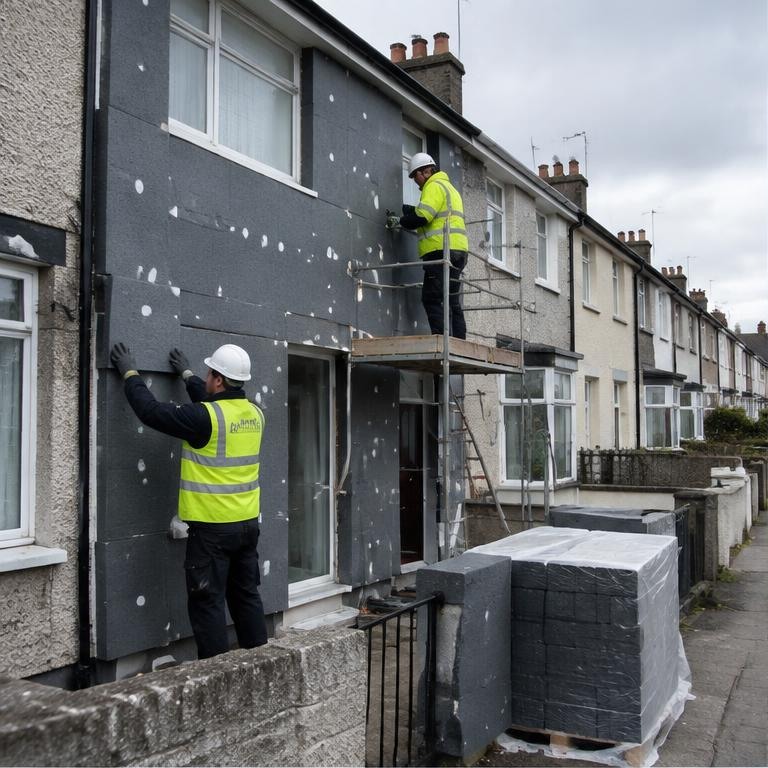
The SEAI's grant scheme covers a wide range of upgrade measures, with grant levels set as a percentage of typical installation costs. Attic insulation grants of up to €1,800 are available — covering 50 to 60% of the typical cost of attic insulation, making it one of the most cost-effective starting points on the retrofit journey. Cavity wall insulation is similarly well supported. Heat pump grants range significantly depending on the type of system and the size of the property. External wall insulation attracts grants of up to €8,000, with higher amounts for larger properties. Solar PV grants remain at €1,800, alongside a 0% VAT rate for the supply and installation of solar panels on domestic premises. The Free Warmer Homes Scheme provides fully funded upgrades for households on qualifying welfare payments — with 32,700 fully funded retrofits for households at risk of energy poverty completed since 2019 — and a higher fixed-amount grant for attic and cavity insulation was introduced from March 2026 for homeowners on qualifying welfare payments.
First-time buyers of existing houses are now specifically supported within the scheme. Approved Housing Bodies and local authorities receive enhanced grant support for the social housing retrofit programme. Green finance options have also expanded significantly, with low-cost retrofit loans available from a range of lenders at rates of approximately 3 to 3.5%. Dr Byrne has been consistent on the finance dimension: "There's really good rates available for a range of providers in the banks. Some low cost loans support you on your journey at 3 to 3.5%."
The Collaborations: Who SEAI Works With
The retrofit programme does not operate in isolation. SEAI works in close collaboration with a range of partner organisations across government, the research sector and the building industry whose contributions are essential to the programme's success.
The Irish Green Building Council is among the most significant of those partnerships. Dr Byrne has acknowledged the relationship directly: "Stephen and the team at the Irish Green Building Council are excellent. We have really strong relationship with them and we work very closely with them. They'll tell us if we're doing things right or wrong, and we've been very much listening because they're really on top of the game in terms of what they do." The IGBC's expertise in building performance standards, including its work on the EU Energy Performance of Buildings Directive, directly informs SEAI's programme design and quality standards.
SOLAS, the Further Education and Training Authority, and the Construction Industry Federation are both central to the workforce development dimension — without the trained contractors, insulation specialists, heat pump engineers and BER assessors to deliver the work, no level of grant funding or demand generation will produce the upgrades. The traditional home pilot programme — which specifically addresses the challenge of retrofitting Ireland's pre-1941 building stock using breathable, heritage-compatible materials — is being developed in collaboration with architects, conservation specialists and research partners, addressing the building physics of stone and mass concrete construction that differs fundamentally from the post-war housing stock that most retrofit measures are designed around.
The Sustainable Energy Communities programme enables area-based retrofit planning supported by SEAI-funded energy master plans — working with local energy communities to develop collective retrofit strategies for estates, villages and urban neighbourhoods rather than relying exclusively on individual homeowner-by-homeowner action.
The Challenge Ahead: Scale, Speed and Equity
The progress made since 2019 is genuine and measurable. The challenge ahead is equally genuine and measurable. 53,984 property upgrades were supported by SEAI in 2024 — against an annual requirement of 75,000 from 2026 to meet the 2030 target. The applications surge of 96% in Q1 2026 suggests demand is building in the right direction. Whether the supply chain, the one-stop-shop network and the contractor register can absorb and deliver that demand — while maintaining the quality standards that SEAI's inspection and audit programme is designed to protect — is the operational test that the rest of 2026 and the four years beyond it will answer.
The equity dimension is one that Dr Byrne returns to consistently. "It's not for rich people at all," he has said. "Get the attic insulated — that's probably about the cheapest, best thing you could do in the first instance. It's the starting point of your journey. If you can do something else another bit next year or the year after, that's great too." The phased, no-regrets approach — doing what is affordable this year and building toward a full retrofit over time — is the philosophical foundation of SEAI's homeowner engagement strategy.
"Anything you do in this space is no-regrets work," Dr Byrne has said. "It's all good. Anything you do to improve the energy efficiency of your home such that it uses less energy and we move towards decarbonisation is good."
The Bottom Line
Ireland's national residential retrofit programme has delivered 244,000 home energy upgrades since 2019, with 58,128 in 2025 alone and a record €640 million committed for 2026. The target of 500,000 homes retrofitted to BER B2 by 2030 requires 75,000 upgrades per year from now — a pace that the Q1 2026 application surge of 96% suggests is beginning to take shape. The one-stop-shop network, the expanded grant scheme, the new awareness campaign and the growing contractor base are all pointed in the right direction. The next four years will determine whether Ireland can convert that direction into delivery at the scale the climate targets demand.
Sustainability Pulse covers climate, energy, ESG and environmental policy through an Irish lens. Subscribe to the Sustainability Pulse Briefing — every Wednesday.