A National Programme Finally Taking Shape
Ireland has approximately 4,000 schools on its national estate, the vast majority of them built before 2008 — before modern energy efficiency standards, before heat pump technology became commercially viable at scale, and before climate action targets were written into law. Most are heated by oil or gas boilers. Many have poor insulation, draughty windows and ventilation systems that were never designed with either energy performance or indoor air quality in mind. For the students and staff inside them, that means buildings that are too cold in winter, stuffy in summer, and expensive to run year-round. For the State, it means a school estate that is one of the largest contributors to public sector carbon emissions in the country.
The plan to fix that has been building since 2017, when the Department of Education and SEAI launched the Schools Energy Retrofit Pathfinder Programme — a pilot designed to test what deep energy retrofit actually looks like in a school building, which solutions work, what they cost, how long they take, and what the supply chain needs to look like to deliver them at scale. Nine years on, that pilot has become a multi-programme, multi-hundred-million-euro national investment — and 2025 and 2026 represent the moment the programme shifts decisively from testing to delivery.
The Pathfinder: Nine Years of Building the Evidence Base
The Schools Energy Retrofit Pathfinder Programme was Ireland's first serious attempt to understand what retrofitting a school actually requires in practice. Jointly funded by the Department of Education and SEAI, it began in 2017 with 10 schools and expanded year by year through different building types, ages and retrofit challenges across the country. The rationale was deliberate and methodical: before committing to a national programme at scale, the State needed a solid evidence base on which retrofit solutions work in Irish school buildings, what they cost, what supply chain capacity is required to deliver them, and how to structure procurement efficiently across multiple simultaneous sites.
By early 2024, the programme had retrofitted 53 schools across 19 counties, with a total spend of around €110 million, and 11 more schools at various stages of progress. A new phase of the programme, with a targeted budget of €50 million, was launched in early 2024 to cover the remaining seven counties not yet included in the Pathfinder — ensuring that by the end of this phase, every county in Ireland will have had at least one school put through the full deep retrofit process. This matters both as a practical matter of geographical equity and as a supply chain development tool: having retrofit contractors, design teams and SEAI assessors working in every county builds the regional capacity that a national programme will ultimately require.
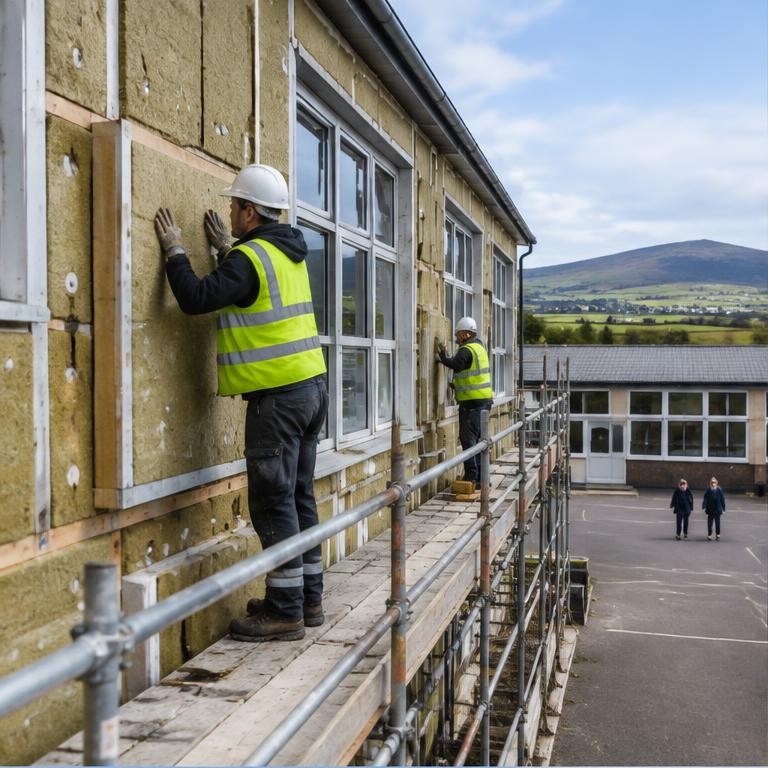
The upgrades delivered under the Pathfinder have been comprehensive in scope. Each school receives a deep retrofit targeting significant energy performance improvement, typically involving insulation upgrades, new windows and doors, airtightness improvements, heating system replacement from fossil fuel to heat pump, renewable energy installation, ventilation upgrades, LED lighting throughout, and BER assessment before and after works. School principals and teachers who have been through the programme have consistently described the difference in comfort levels — warmer in winter, better air quality year-round, quieter — as transformative for the teaching and learning environment, not just for the energy bill.
The REPowerEU Programme: The Biggest School Retrofit Investment to Date
While the Pathfinder has been building the evidence base and the supply chain, a separate, faster-moving and larger programme has been running in parallel. Ireland secured €240 million in total under the EU's REPowerEU programme — made up of a €90 million direct allocation and an additional €150 million transferred from the Brexit Adjustment Reserve — as part of the EU's plan to rapidly reduce dependence on Russian fossil fuels following the war in Ukraine and accelerate the energy transition across member states. Of Ireland's REPowerEU allocation, €86 million has been directed specifically at school building retrofits under the REPowerEU Pathfinder Programme, operated by the Department of Education and Youth.
The programme moved at a pace that is unusual for Irish public infrastructure projects. A pool of 40 schools across five counties — Kildare, Meath, Offaly, Wicklow and Wexford — was identified for the initial assessment phase, selected using data from the pilot phase of a new Schools Energy Inventory, which was completed with support from the European Investment Bank. From appointment of design teams to reaching tender stage took just six months — a timeline that Minister for Education and Youth Helen McEntee described as "exceptional" given the scale and complexity of the programme. Eight multi-disciplinary design teams and twelve contractors entered into contract under the programme, building exactly the kind of specialist school retrofit contractor capacity that the Pathfinder Programme had been trying to develop over the previous eight years.
In June 2025, Minister McEntee confirmed that 28 of the 40 assessed schools would proceed to deep retrofit construction works this summer, representing the €86 million investment in full deployment. Each of the 28 schools is receiving: heat pumps replacing existing fossil fuel heating systems, mechanical heat recovery ventilation to improve indoor air quality while retaining heat, LED lighting throughout, full fabric upgrade including improved insulation and airtightness, and electric vehicle chargers on site. The target for every school is a minimum Building Energy Rating of B — a step change from the D and E ratings that many of these schools carried before works began. Twenty-four of the 28 schools are also receiving electrical infrastructure upgrades by ESB Networks, specifically to accommodate the new heat pump systems, which require a different electrical supply capacity than the oil and gas boilers they are replacing.
The 12 schools from the original 40 that did not proceed to construction under the REPowerEU programme were excluded on grounds of value for money, planning permission delays or tendering challenges — not removed from the retrofit pipeline. The Department has confirmed it is assessing opportunities for those schools to progress through other programmes, including the Climate Action Summer Works Scheme.
The Schools Energy Inventory: The Data Foundation for What Comes Next
One of the most significant strategic elements of the REPowerEU programme is not the 28 schools being retrofitted this summer, but the data infrastructure being built alongside them. The Schools Energy Inventory — a detailed energy assessment of the condition, energy performance and retrofit potential of individual school buildings — began as a pilot covering five counties: Kildare, Meath, Offaly, Wicklow and Wexford. Using the REPowerEU funding, the Department of Education is now expanding that inventory nationwide, with surveys currently underway across the remaining 21 counties.
When complete, this inventory will give the State something it has never had before: a verified, building-by-building picture of the energy performance and retrofit potential of the entire national school estate. That data will be the foundation on which a genuinely national deep retrofit programme — covering thousands of schools rather than dozens — can be planned, prioritised and funded. It is the essential precondition for scaling from what is currently a significant programme to the full transformation of the school estate that Ireland's climate commitments ultimately require.
The Climate Action Summer Works Scheme: The Annual Upgrade Machine
Running alongside the deep retrofit programmes is a third, broader initiative: the Climate Action Summer Works Scheme, which was launched in November 2025 with a €90 million investment package covering 297 projects across all 26 counties. This is the first tranche of approvals under the Department of Education's National Development Plan 2026-2030, with Minister McEntee committing to annual approval rounds going forward as a standing feature of the school capital programme.
The Climate Action Summer Works Scheme operates at a different scale from the deep retrofit programmes — covering smaller and medium-scale building works typically carried out over school summer holidays. Works under the scheme include roof upgrades, electrical and mechanical improvements, window replacements, energy-efficiency measures and essential maintenance. Of the 297 projects approved for 2026, 198 are under the new Climate Action Summer Works Scheme and 99 are completing projects from the previous Summer Works Scheme. A major specific investment within the scheme is €30 million ring-fenced for the modernisation of science laboratories in 60 post-primary schools — directly supporting the rollout of the new Leaving Certificate science curriculum and ensuring the physical infrastructure of schools keeps pace with curricular reform.
Schools participating in the scheme are required by legislation to register their energy use with SEAI and commit to submitting energy returns before any payments can issue — embedding energy monitoring as a condition of capital funding rather than an optional extra.
The Capital Framework: How This All Fits Together
The school retrofit programmes sit within a larger capital framework. The Department of Education received a capital allocation of €1.6 billion for 2026 — a 7% increase on 2025 — covering over 300 school building projects with the majority expected to be completed in 2026 and 2027. The NDP 2021-2030 has committed €4.4 billion to school infrastructure overall, with the rolling 5-year funding envelope updated annually to reflect progress and emerging needs. Within that envelope, the climate and energy dimension is explicitly prioritised: the Programme for Government 2025 commits to a world-class education system, and the Department's capital programme specifically identifies the decarbonisation of the school estate as a core delivery objective alongside capacity expansion and special educational needs provision.
For the 4,000 schools on the national estate — the vast majority of which have yet to receive a deep retrofit — the combination of the Pathfinder Programme, the REPowerEU investment, the expanding Schools Energy Inventory and the annual Climate Action Summer Works Scheme represents the most coherent and well-funded approach to school decarbonisation Ireland has yet assembled. The question now is whether the pace of delivery — 28 schools receiving deep retrofits this summer, 297 projects underway through the summer works scheme — can be sustained and accelerated at the scale the inventory data will ultimately demand.
The Bottom Line: Ireland's school retrofit programme has moved from a nine-year pilot into a multi-programme, multi-hundred-million-euro delivery phase. The 28 schools receiving deep retrofits this summer, the 297 projects underway under the Climate Action Summer Works Scheme, and the nationwide Schools Energy Inventory now being built across all 26 counties together represent a genuine step change in ambition and delivery. The estate that needs retrofitting numbers in the thousands. The programme to do it is, at last, properly underway.
Sustainability Pulse covers climate, energy, ESG and environmental policy through an Irish lens. Subscribe to the Sustainability Pulse Briefing — every Wednesday.