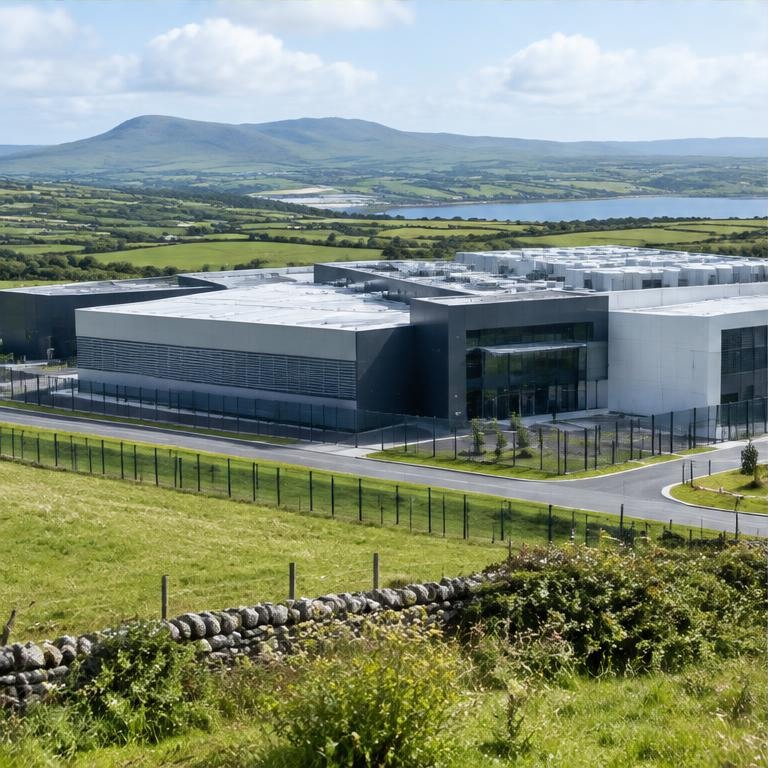
On 4 June 2026, the CSO published a snapshot of key environmental indicators for Ireland to mark World Environment Day. Buried inside the data release was a figure that went relatively unreported despite its significance: large energy users — a category that includes major data centres alongside significant industrial consumers — accounted for 31% of total metered electricity consumption in Ireland in 2024. In 2015, that figure was 15%. In nine years, Ireland's large energy users have doubled their share of the national electricity grid, going from one euro in every seven spent on electricity to nearly one in three.
To put that in context: a single category of consumer, concentrated in a relatively small number of facilities, now takes up nearly a third of the electricity generated in one of Europe's most energy-hungry economies per capita. And the trajectory is upward, not plateauing. Data centres alone are projected to account for 25-33% of Ireland's total electricity demand by 2030, according to the Climate Change Advisory Council's 2026 review, with EirGrid's own modelling suggesting overall demand could rise by up to 50% over the next decade if all proposed large energy user connections proceed.
What "Large Energy Users" Actually Means
The CSO definition of large energy users covers the highest consumption tier of metered electricity customers — those consuming electricity at a scale that separates them from normal commercial and industrial users. In practice, the category is dominated by data centres operated by hyperscale cloud and technology companies: Microsoft, Meta, Amazon Web Services, Google and Apple all operate significant data centre campuses in Ireland, concentrated primarily in Dublin and the surrounding counties but expanding into the Midlands, Munster and along the western seaboard as the Dublin grid reaches capacity. Pharmaceutical manufacturing plants, which form another significant part of Ireland's industrial base, also fall into this category, though their per-facility consumption is substantially lower than the hyperscale data centres.
The distinction matters because different large energy users have different profiles in terms of growth trajectory, location, energy flexibility and potential to shift to renewable sources. A pharmaceutical plant is typically operating at relatively stable load, has predictable consumption patterns, and is unlikely to significantly increase its electricity demand over the next five years. A hyperscale data centre, by contrast, may expand its server capacity multiple times as AI workload requirements grow, has consumption that is highly correlated with global demand for cloud computing services, and is actively planning additional facilities on the same or adjacent sites. The 31% figure is best understood not as a static descriptor of the current state but as a number that is still moving, primarily driven by data centre growth.
The Grid Consequence: EirGrid's Warning
The consequences of large energy user growth for the national grid are no longer theoretical. EirGrid's All-Island Resource Adequacy Assessment, published in February 2026, warned that electricity demand will exceed supply capacity during peak periods between 2026 and 2028, creating conditions under which the grid operator may need to reduce supply to certain categories of consumer to maintain system stability. This is not a remote risk scenario — it is EirGrid's central projection for a system in which renewable energy generation is growing but not fast enough to match the combined growth in data centre demand, household electrification through heat pumps and EVs, and continued industrial consumption.
The Commission for Regulation of Utilities responded in 2022 with a de facto moratorium on new data centre grid connections in the Dublin and Greater Dublin area, which remains in effect for large energy users seeking direct grid connections. The government's response has included the development of mandatory renewable energy commitment requirements — new data centre connections must demonstrate a pathway to meeting 80% of their electricity demand from renewable sources — and a National Private Wires Policy Framework that would allow large energy users to connect directly to renewable generators via dedicated cables, removing them from the public grid system and reducing the strain on EirGrid's transmission infrastructure.
The Household Cost That's Being Passed On
The grid investment required to connect and supply large energy users doesn't come free. ESB Networks increased household electricity bills by €1.75 per month from October 2025 specifically to fund grid infrastructure upgrades — upgrades driven in significant part by data centre connection demand. Friends of the Earth Ireland's analysis, published in May 2026, projects that data centre growth will add €1.43 billion to Irish household electricity bills between 2025 and 2034. Over the 2015-2023 period already elapsed, the same analysis found that data centre-related grid costs added €715 million to household bills.
This is the specific social cost that has changed the tone of the data centre policy debate in Ireland over the past two years. When large energy users represented 15% of consumption, the grid cost was manageable and distributed broadly across a growing economy. As the share approaches a third of national consumption, the question of who bears the cost of the grid investment needed to serve that consumption becomes more politically and socially pointed. The poorest households — those on fixed incomes, in older homes, with the least capacity to reduce their own consumption through efficiency measures — absorb the same per-unit grid cost as higher-income households but feel it proportionately more. Friends of the Earth's analysis found that the poorest households paid an additional €209 on electricity bills between 2021 and 2023 specifically because of data centre-related costs.
The Counterargument: Economic Contribution Is Real
The data centre industry's contribution to the Irish economy is also real and documented. KPMG's analysis for the Department of Enterprise, commissioned in 2026, valued the data centre sector's contribution to the Irish economy at €7.3 billion. Corporation tax, paid disproportionately by the US technology multinationals that operate the data centres, accounted for approximately one third of all Irish tax revenues in 2025. IDA Ireland continues to position Irish data centre capacity as a strategic economic asset, noting that the sector competing with France's €200 billion and Germany's €100 billion in announced data centre investment means that capacity restrictions in Ireland risk diverting investment — and its tax contribution — permanently to other European jurisdictions.
The policy challenge is to hold both of those things as true simultaneously: the economic contribution is real and the grid, environmental and social costs are also real. Ireland is not in a position to simply refuse large energy user connections without economic consequence, but neither can it absorb unlimited demand growth without investment in renewable generation, grid infrastructure and pricing mechanisms that ensure the cost is distributed fairly.
The Bottom Line
The CSO's World Environment Day data confirmed what the energy sector already knew: large energy users have doubled their share of Ireland's electricity consumption in under a decade and are not yet close to their peak. How Ireland manages the grid, cost and climate consequences of that growth over the next four years — before the 2030 targets require a reckoning — is one of the most consequential infrastructure policy questions the country faces.
Sustainability Pulse covers climate, energy, ESG and environmental policy through an Irish lens. Subscribe to the Sustainability Pulse Briefing — every Wednesday.