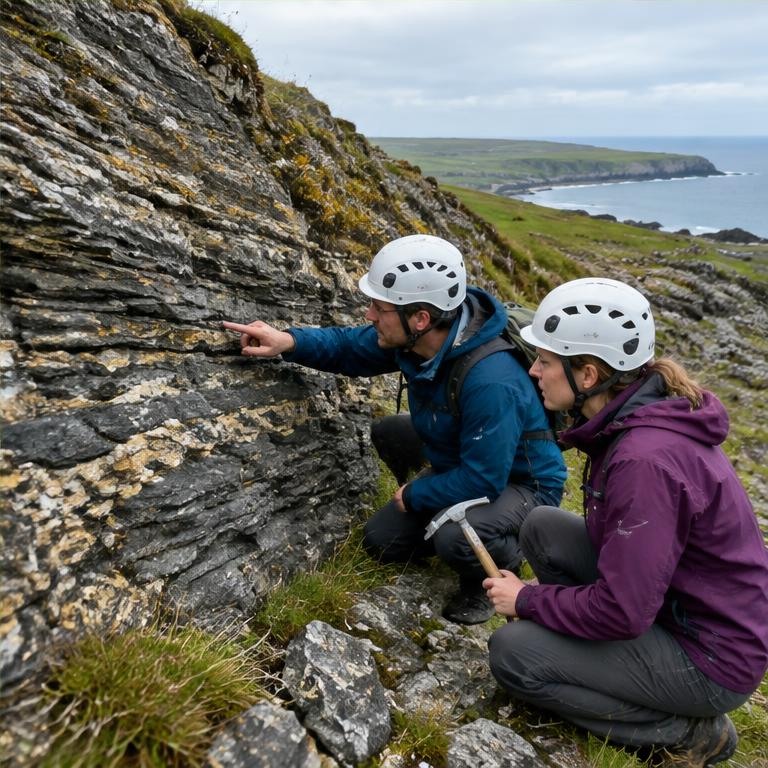
A School Built on Understanding the Ground Beneath Our Feet
The UCD School of Earth Sciences is the largest geoscience school in Ireland, offering both undergraduate and postgraduate education and hosting a research community drawn from over 15 countries. Its roots trace back to the Royal College of Science for Ireland, founded in the 19th century with a focus on geology and natural resources, which was absorbed into University College Dublin in 1926 as part of the Faculty of Science and Engineering. What began as a practical discipline concerned with mining, minerals and the physical landscape of Ireland has evolved, across a century, into one of the country's most internationally connected and policy-relevant scientific institutions, with research that now spans volcanology, geothermal energy, hydrogen storage, peatland restoration, fault analysis, marine geology and Antarctica's ancient landscape.
The school's research funding typically exceeds €2 million per year from national and international sources, and its work is published regularly in leading international journals across the full range of geoscience disciplines. It sits at the intersection of fundamental science and real-world application, running both pure research programmes and applied projects that feed directly into Irish and European energy policy, climate action strategy and natural resource management. For a school operating within a single Irish university, that breadth of reach is genuinely unusual.
iCRAG: Where Applied Geoscience Meets National Policy
At the centre of the school's research infrastructure is iCRAG, the Irish Centre for Research in Applied Geosciences, which the UCD School of Earth Sciences hosts as lead participant. iCRAG is one of 16 national Science Foundation Ireland Research Centres, a status that places it among Ireland's most strategically important research institutions. Under its current director, Professor Sarah Gleeson, a Research Ireland Professor and Full Professor in Sustainability Geoscience at UCD who relocated from Germany's GFZ Helmholtz Centre for Geosciences in Potsdam in 2025, iCRAG conducts research across areas directly critical to society and the economy: the sustainable discovery of raw materials, the energy transition, securing and protecting groundwater, geohazards, and the crossover between geoscience and the social sciences.
The scope of iCRAG's work matters because it positions UCD's geoscience research at precisely the point where Irish policy is under most pressure to deliver. Ireland's energy transition, its legally binding climate targets, its groundwater security and its critical mineral needs for battery technology and renewable energy infrastructure are all questions where earth science research provides the foundational evidence that policy decisions are built on. When the Irish government launched its Call for Evidence on Hydrogen Geological Storage this month, it was building directly on the kind of subsurface characterisation and geological storage research that iCRAG and the UCD School of Earth Sciences have been advancing for years.
The Research Making Headlines Right Now
Several strands of the school's current research are particularly timely given Ireland's 2026 policy agenda. The UCD Sustainable GeoEnergy Research Group, which won the iCRAG Impact Award in 2025 for its work advancing geological decarbonisation of energy systems, is actively working on geothermal resource modelling across Ireland, Northern Ireland, Scotland and internationally, through projects including GeoNORM on the UCD campus itself, the National Geothermal Database covering the whole island, the Geothermal Energy Momentum on the Island of Ireland project known as GEMINI, and GeoStoreIE, which focuses on geological storage potential in Ireland's offshore basins. The group's research has informed both national and international energy policy discussions, and a postdoctoral position is currently open within the group specifically to advance the characterisation and 3D modelling of geothermal systems in limestone-shale host rocks and deep hot sedimentary aquifers across Ireland, the UK and the EU.
Peatlands are another live research front. Funding has recently been awarded to the school for research specifically aimed at monitoring and restoring peatlands for climate action, building on earlier work by the school's researchers in satellite-based InSAR surface displacement monitoring of raised peatlands. Separately, the AI2Peat project, a collaboration between the UCD School of Earth Sciences, UCD School of Computer Science, the CeADAR centre and iCRAG, was shortlisted in UCD's 2025 Research Impact Case Study Competition for its work building an all-Ireland AI platform to power smarter peatland management. With over 20% of Ireland's land area covered by peat and peaty soils, research that improves how Ireland monitors and manages its peatlands has direct implications for the country's climate targets, given that degraded peatlands are a significant source of carbon emissions and restored peatlands are one of the most effective natural carbon sinks available.
A Major International Award in 2026
Associate Professor Claire Harnett of the UCD School of Earth Sciences was awarded the 2026 European Geosciences Union Arne Richter Award for Outstanding Early Career Scientists, one of the most prestigious recognitions available to a young scientist working in the geosciences in Europe. The award recognised her exceptional contributions through field and experimental studies modelling the growth and collapse of volcanic structures, and geotechnical applications that have led to improved assessments of volcanic instability and hazards. Harnett is a lead researcher on the ERC-funded RottnRock project, and her research focuses on numerical modelling of volcanic environments, particularly the stability of lava domes and calderas, with implications for hazard assessment in volcanically active regions worldwide. That a UCD Earth Sciences researcher is working at this level of international recognition in 2026 is a useful measure of the school's standing in the global geoscience community.
Also in 2025, iCRAG's Research Paper of the Year was awarded to Professor Dave Chew of UCD for a publication offering fresh insight into the evolution of Antarctica's ancient landscape, providing evidence that West Antarctica was once shaped by large river systems, and demonstrating the power of modern analytical techniques in sedimentary provenance research. The study drew on broad international collaboration across multiple institutions and showcased how UCD geoscience research operates at a genuinely planetary scale, using Irish-developed analytical methods to answer questions about Earth's deep history that carry direct relevance to understanding the dynamics of major ice sheets today.
What Students Actually Study: From Field Geology to the Offshore Wind Industry
The UCD School of Earth Sciences offers a BSc in Geology entered through the common Science stream, alongside an MSc in Subsurface Characterisation and Geomodelling, and MSc and PhD by research. The undergraduate programme is built around a progression from foundational science into applied, field-based and digital skills. First year modules cover Introduction to Earth Sciences, Understanding Earth Systems and Earth and Humanity. Later years bring Field Geology, Earth Environment and Society, and elective options, alongside independent research projects and a Geoscience Work Placement in third year, typically hosted by resource-based, geotechnical, civil engineering or environmental consultancy companies, giving students direct industry experience before they graduate.
The postgraduate research offering covers a broad spectrum of specialities, with a seamless transition between pure and applied research across the school's multiple research groups. Graduates from the programme go into roles spanning offshore wind, geotechnical engineering, environmental consultancy, the mining sector and academic research. One recent graduate described her route from UCD Earth Sciences into the offshore wind industry directly: "Working in an industry that is constantly taking strides towards a greener future for Ireland is so exciting." It's a quote that neatly captures what the school's programmes are increasingly producing: scientists equipped not just to understand the earth, but to help Ireland use what it knows about it to build a cleaner energy future.
The Bottom Line
The UCD School of Earth Sciences is doing research that matters far beyond the lecture hall, from the geothermal systems beneath Irish soil to the ancient river systems of West Antarctica, from AI-powered peatland management to the geological storage solutions Ireland will need if its hydrogen ambitions are going to work. In a year when Ireland is asking some of the biggest questions about its energy future, the school providing many of the answers is quietly one of the most important research institutions on the island.
Sustainability Pulse covers climate, energy, ESG and environmental policy through an Irish lens. Subscribe to the Sustainability Pulse Briefing — every Wednesday.